Who Was the Real Thomas Rawlings?
If you’ve joined The Ghost Walk Padstow, you’ll already have met Thomas Rawlings.
Or at least, you’ll have met my version of him.
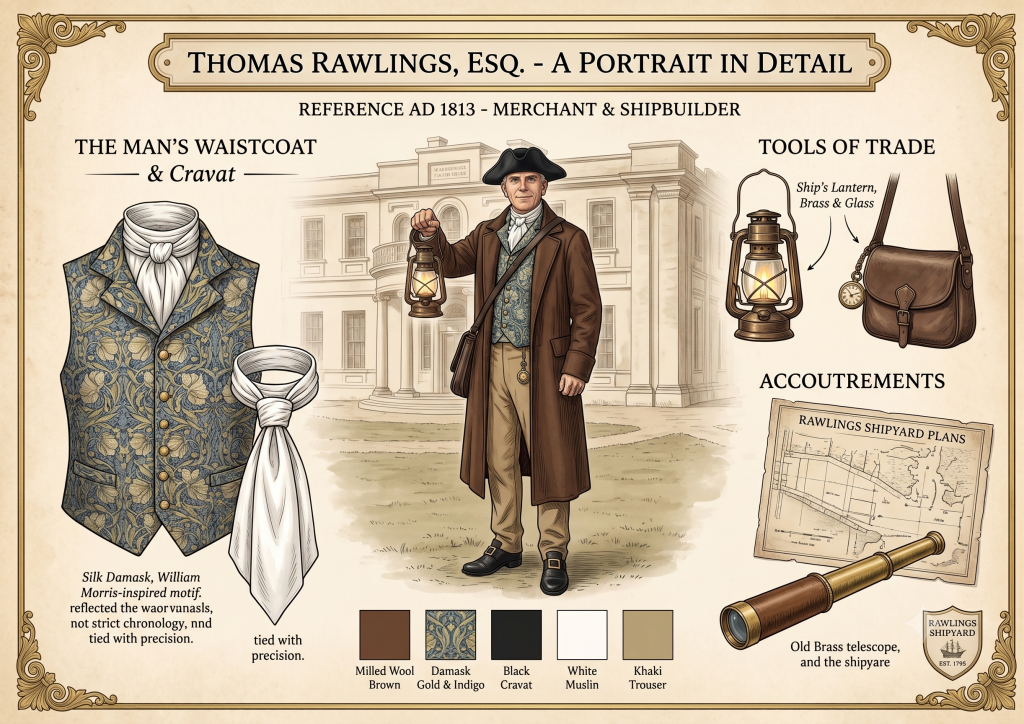
I’m Geoff Monk, and several evenings a week I put on the waistcoat, brown coat and tricorn hat and become Thomas Rawlings, Georgian merchant, banker, shipowner and occasional teller of some of Padstow’s darker stories.
But Thomas wasn’t invented for the Ghost Walk. He was very real, and the more I’ve discovered about him, the more interesting he’s become.
A Padstow merchant
Thomas Rawlings was born around 1757, the son of William Rawlings, a successful merchant who had moved to Padstow from St Columb. His brother, also William, took a rather different career path and became Vicar of Padstow in 1790, remaining there for an extraordinary 46 years.
So, for a considerable period, one Rawlings brother was involved in the commercial life of Padstow while the other occupied the pulpit at St Petroc’s Church. Between them, the family must have been difficult to avoid.
Thomas followed his father into business and became one of Padstow’s leading merchants. His interests included shipping, property, trade and banking. The family firm traded as Thomas Rawlings & Son and became associated with the Padstow Bank, one of the private country banks which existed long before our modern national banking system.
There is even a surviving letter written by Thomas in November 1805 in which he complains about being burdened with local banknotes from Cornish towns where he had few business connections. He was happy to exchange notes from places such as Truro, Bodmin and Falmouth for London paper, but less enthusiastic about notes issued elsewhere.
It’s a wonderfully ordinary business problem. More than 200 years later, you can almost hear the exasperated banker behind the polite Georgian language.

From merchant to High Sheriff
Thomas had become a wealthy and important man.
In 1803 he was appointed High Sheriff of Cornwall, appearing in the official record as “Thomas Rawlings, of Sander’s Hill, Padstow”. The position carried considerable status — and considerable expense — and marked just how far the Rawlings family had risen.
Saunders Hill was Thomas’s grand country residence on rising ground above Padstow. An account published only a few years after his death described it as a mansion built of Portland stone in the Ionic style. The Rawlings estates extended well beyond Padstow into other parts of Cornwall.
Closer to the harbour, the Rawlings family was also associated with the building which is now St Petroc’s Hotel.
That gives me one of my favourite connections with the Ghost Walk. When we stand outside St Petroc’s today, talking about Padstow two centuries ago, we’re standing beside a building which formed part of the Rawlings family’s own story.
A visitor to Rawlings’ Padstow
We can even catch a glimpse of Thomas Rawlings through the eyes of someone who visited Padstow during his lifetime.
A traveller writing in the early 1800s was struck by Padstow harbour at high tide, describing it as having the appearance of a “noble lake”. He thought Padstow itself a place of “wealth and respectability”, with improvements being made around the town.
And one man was singled out by name.
Among the improvements, the writer praised “the walks and plantations of Mr. Rawlings”, saying they had been “executed with taste” and, when mature, would become “a considerable ornament to the town”.
It’s a lovely little detail because the plantations were apparently still young. Thomas wasn’t simply living in a grand house above Padstow. He was actively landscaping and planting around it, and doing so on a scale noticeable enough for a visitor to mention.
The same traveller described Padstow as a busy trading port, exporting large quantities of fish and importing hemp and timber from Russia, Denmark and Norway. It gives us a glimpse of the town Thomas knew — prosperous, maritime and looking firmly out towards the wider world.
“Know thyself, and learn to suffer”
There’s another lovely glimpse into the family.
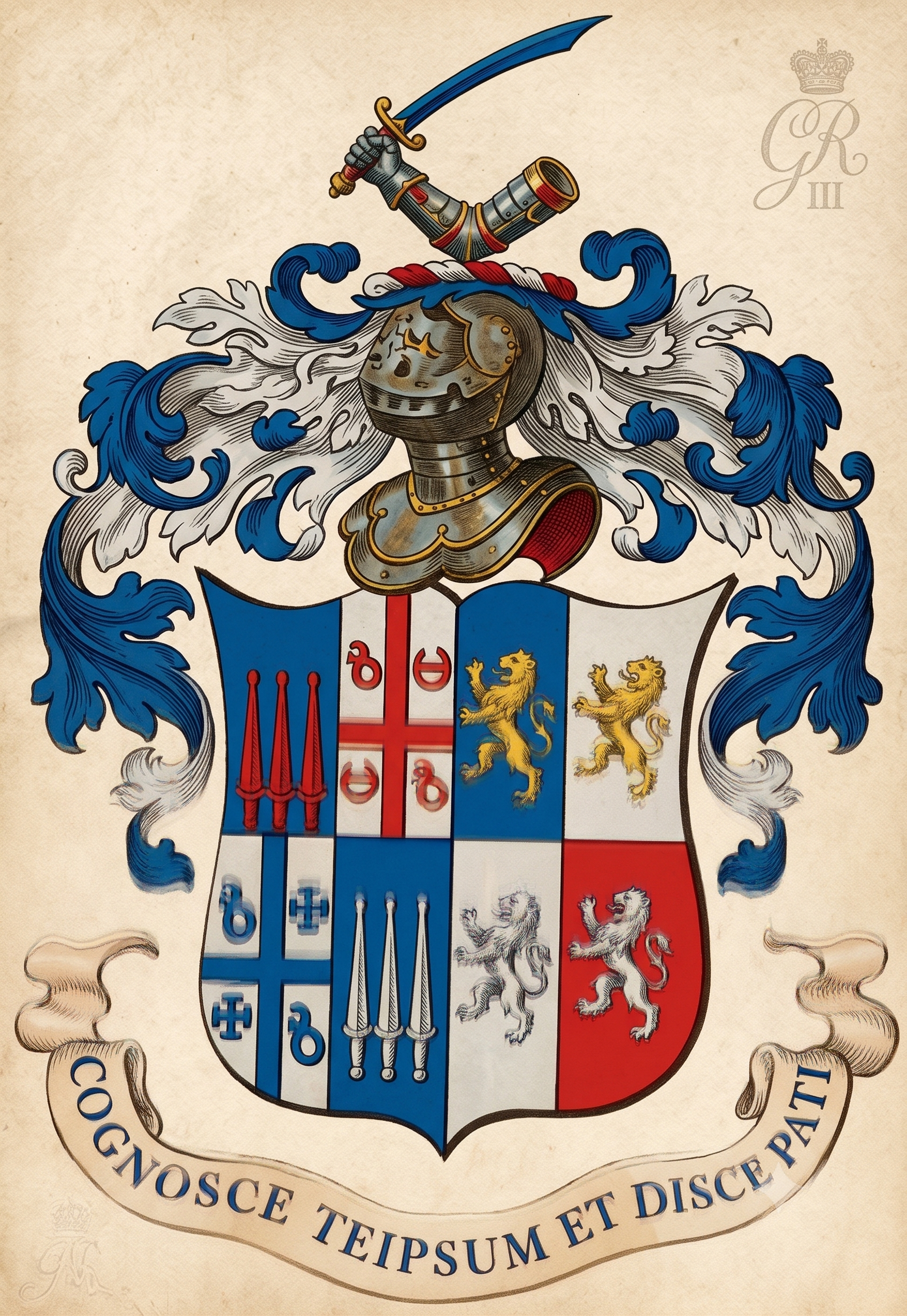
Thomas’s father William was described as a thoughtful, well-read man with a substantial library of Greek and Latin classics. The family motto recorded in a nineteenth-century account was:
Cognosce teipsum, et disce pati.
Or, in English:
“Know thyself, and learn to suffer.”
Not perhaps the cheeriest family motto ever devised, but rather a good one for a ghost walk.
The Rawlings family also appears in Padstow’s charitable life. Records of the Padstow Harmonia Charity in 1820 show Rawlings women in leading positions, including its president, treasurer, secretary and others responsible for clothing and relief. That year the charity recorded helping 128 people with money or clothing.
Then it all went wrong
Thomas’s success didn’t last.
The years following the Napoleonic Wars brought serious economic difficulties. Shipping, mining and the small country banks were vulnerable, and eventually the Padstow Bank and the Rawlings business failed.
The empire Thomas and his family had built collapsed into bankruptcy. Notices from the period record stock from the firm being sold to pay its debts — even the wine.
Thomas died in 1820, aged about 63, with his financial affairs still unresolved. Saunders Hill was sold and the great house was subsequently demolished.
A man who had risen from a successful merchant family to become High Sheriff of Cornwall had lived long enough to see much of his fortune disappear.
Perhaps that family motto was more appropriate than it first appears.
And then, 200 years later…
This is where I come in.
I’ve worked as an actor, improviser and role-player for many years, and when I created The Ghost Walk Padstow I wanted a guide who actually belonged to the town’s past. I didn’t particularly want to play a generic Victorian undertaker or mysterious fellow in a top hat.
Thomas was far more interesting.
Here was a real Padstow man who knew these streets when the harbour was crowded with sailing vessels. His family lived here. He traded here. He banked here. His brother preached in the church we visit on the walk. He knew the world around Prideaux Place and the old inns and streets of Georgian Padstow.
Of course, the Thomas you meet on the Ghost Walk is a character. I don’t pretend that we know exactly what he sounded like, what jokes he made or what he thought about ghosts. There are still gaps in his history, and occasionally the records raise as many questions as they answer.
But that’s part of the fascination.
Every so often another old document, newspaper notice or forgotten reference turns up and we learn something new about him.
So when I put on the hat and introduce myself with the words “Thomas Rawlings”, I’m playing a part.
But the man himself really did walk these streets.
And, more than two centuries later, he’s walking them again.
Acknowledgements for contributions: Malc McCarthy